Much like humans, elephants can face a surprising number of dental challenges. At this time of year, many of us are finishing off the last of our chocolate Easter eggs, and it’s easy to forget that for elephants, the state of their tusks and teeth is far more than a cosmetic concern – it’s essential for their health and survival.
Elephants have two incisor teeth, known as tusks, along with four molars hidden away inside their mouth. Together, these teeth are used for almost every aspect of daily life: stripping bark, grinding vegetation, and foraging for the vast quantities of food they need. Unlike humans, who get one set of adult teeth, elephants cycle through six sets of molars over their lifetime. A single molar tooth weighs around a whopping 2kg! As each set wears down from years of heavy use, a new one moves forward to replace it.
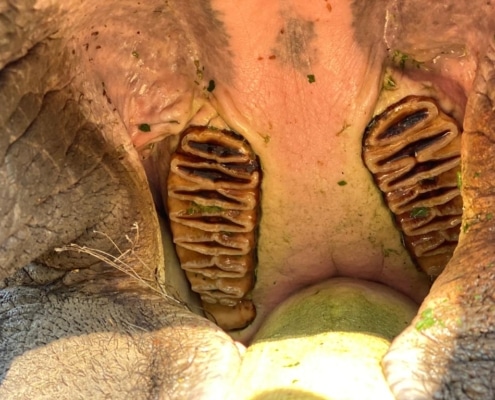
A single molar can weigh as much as 2kg! Can you imagine carrying around four of those in your mouth? Image credit: Herd Trust
To learn more about the world of elephant dentistry, we spoke with Dr. Fieke Molenaar, an RCVS-recognised Specialist in Zoo and Wildlife Medicine and a highly valued STEF Trustee.
How would you tell an elephant is having tooth pain?
Like all herbivores, the teeth play an important role in the grinding down of the rough fibres they consume. Discomfort associated with molars will lead to reduced chewing activity. Faecal boluses may therefore increase in size. Less frequently, an elephant may also drop their food. Overall, molar discomfort may lead to a loss of body condition. Pain associated with the tusks can be shown by increased touching of the tusk with their trunk, and avoiding use of the tusk for day to day activities.
Do all elephants get tooth pain?
Elephants seldom get tooth pain, but at the changing of a molar (when one molar falls out, before it is fully replaced by the next molar) they may have chewing difficulties. On occasion, they may develop tooth root infections secondary to trauma. These lead to painful swellings.
What dental disease is most commonly encountered in elephants?
Tusk fractures are the most common issue – particularly in young Asian elephants, whose tusks are more fragile, especially in unstable social groups. Adult elephants also experience fractures, these can be related to interactions with concrete and metal from enclosures, and in-fighting.
Molar issues are most common in older elephants. Because their molars move forward throughout their life, anything that disrupts this progress can cause abnormal wear between the upper and lower teeth, which worsens the issue. Some molars can rotate instead of drop out, trapping food. Spurs on opposing molars can cause lesions of the tongue and lip.
In captivity, are routine oral health checks performed?
Keepers should be checking their animals every day. If hands-on (Free contact), such as in range country working elephants, this may include inspection of the molars as well as the tusks. If hands-off (Protected contact), such as in Western zoos, keepers can only visually inspect the tusks from a distance, but they can inspect appearance of faecal balls.
What happens during a regular dental check-up?
Elephants in managed care have regular dental exams, and the method used is determined by the individual elephant’s training and how it behaves.
Depending on the individual, positive reinforcement training may teach elephants to:
- Open their mouths for inspection, by raising their trunks
- Offer their tusks for inspection
This cooperative approach allows for inspections without stress, which is far better for the elephant than relying on chemical restraint (sedation, general anaesthetic). Also, as the head of the elephant is very heavy, it is much better that they lift it themselves, to allow a good view. Some very well trained individuals may allow a video inspection of the oral cavity with a camera on a stick.
What dental treatments or interventions have you carried out, and how successful have they been?
I’ve been involved with both molar extraction and tusk extraction. These are major team efforts, and if the tusk was broken a long time ago, the chance of easy extraction is slim. Tertiary dentine will develop, leading to fusion of the tooth with the bone. We prefer, in cases of tusk fractures, to carry out a partial root canal treatment instead of extracting the tooth. This will allow the elephant to retain its tusk and it will keep growing as the elephant gets older. Root canal treatment is a specialist veterinary dentistry skill.
What are the biggest obstacles you face in diagnosing or treating dental issues?
Access is the biggest problem. Access to the elephant, access to anaesthetic skills (some zoos need to call in elephant vets for this), access to equipment (elephant dentistry is a specialist field, only a small number of people have the correct equipment and skills). We created the Elephant Dental Vets group to fill this void, and ensure everyone knows how to get access to these skill sets.
Have you observed links between dental disease and changes in elephants behaviour, feeding patterns or mortality?
Yes. Elephants with oral pain will head press, and they will also stuff dirt into the painful place (like a fractured tusk). They will often touch their face with their trunk. And faecal balls of elephants with molar issues will increase in width and especially length. They can lose body condition. In severe cases, especially in case of tooth infections, they may develop sepsis, which could eventually lead to death.
Do mahouts, keepers or veterinarians receive training in recognising dental disease, and would further resources in this area be useful?
Training is still in its infancy. Knowledge sharing is improving, and hopefully in the next few years there will be more references and guidelines available to all.
Conclusion
There is ongoing progress in elephant dentistry. Prevention and consistent monitoring are extremely important. With increased training of elephants to accept basic checks, early detection of issues becomes more probable, which enables management without major interventions.
Although more research is necessary, early identification and correct management can significantly enhance their overall well-being and ease.
STEF is always learning and changing its care routines to give the elephants under its care the best treatment possible, even for something like a sore tooth.
For more information, please visit:
At STEF, protecting elephants has always been at the heart of everything we do. But behind every conservation project, education programme, and rescued elephant is a community of people who believe deeply in our mission. Among them is a very special group we are proud to shine a spotlight on – our Arts Ambassadors.
Our Arts Ambassadors are kind, generous individuals from across the creative world who use their talents to support elephant conservation. From visual artists and writers to performers and creatives working in many disciplines, each ambassador brings something unique. What unites them is a shared passion for elephants and a desire to make a positive difference.
Creativity With Purpose
Art has an extraordinary ability to connect people emotionally, tell powerful stories, and inspire action. Our Arts Ambassadors help us harness that power. Through donated artwork, creative collaborations, performances, written works, and the generous gift of their time, they help STEF raise both vital funds and awareness.
Some ambassadors create pieces inspired by elephants and the landscapes they inhabit. Others support fundraising initiatives, lend their voices to campaigns, or help us reach new audiences through their networks. Every contribution, whether large or small, plays a meaningful role in supporting our projects and amplifying our message.
With Our Deepest Thanks
We are incredibly grateful to every Arts Ambassador who supports STEF. Their generosity, creativity, and belief in our work mean more than words can express. Each ambassador is an important part of our extended STEF family, and we are honoured to work alongside them.
A Growing Community
Our Arts Ambassadors page will continue to grow as more talented individuals from the visual arts, literature, and performing arts join us on our journey. We’re excited to introduce you to new ambassadors over time and to share the wonderful ways they support elephant conservation.
And who knows – could that be you?
If you are an artist, writer, performer, or creative who feels inspired by elephants and would like to use your talents to support our work, we would love to hear from you!
The Big Give is LIVE!
We’re thrilled to announce that STEF is taking part in the Big Give Christmas Challenge, the UK’s largest match-funding campaign. During the week of December 2nd to the 9th, your generosity will go twice as far, thanks to a matching gift.
A £10 donation turns into £20, a £25 donation becomes £50, and a £50 donation grows to £100, providing twice the support for elephants in Southern Thailand.
What is the Big Give?
The Big Give brings together charities, supporters, and philanthropic funders to match public donations. The Big Give platform will automatically double your donation during this week-long event, maximising the impact of your generosity and helping us achieve new milestones.
Why it matters
Your support helps us provide:
- Life-saving medical care for sick and injured elephants
- Specialist treatment at our hospital and mobile clinic
- Ongoing food and rehabilitation for elephants recovering from trauma and illness
- Education and outreach to improve welfare standards across Southern Thailand
Every contribution — big or small — plays a vital role.
Small actions create BIG impact, and together we can protect these magnificent, intelligent elephants for generations to come. ✨
Watch our videos above to see how your support transforms lives.
To donate to the campaign, please visit: Free Veterinary Care for Endangered Elephants – Big Give
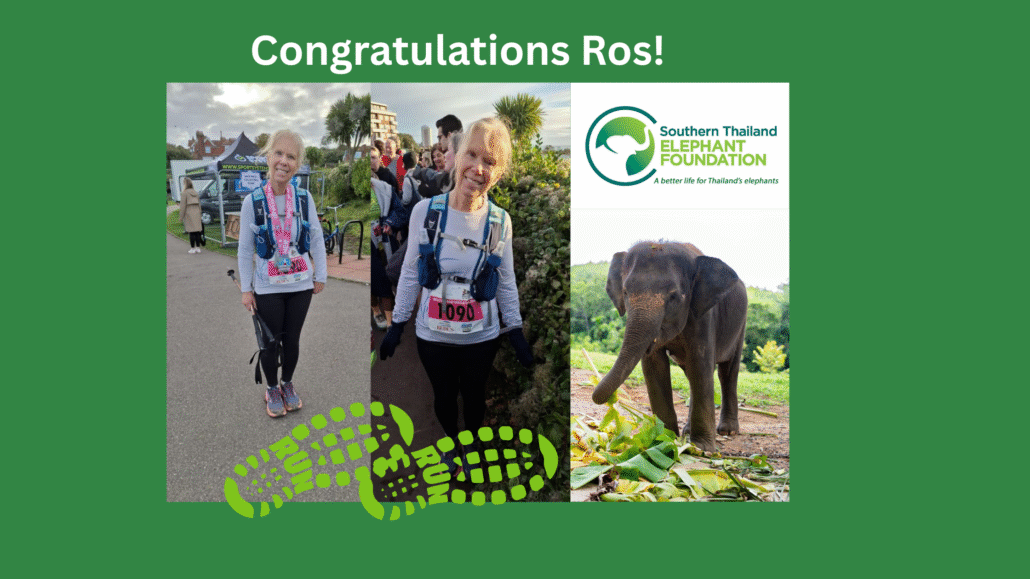
A 70th Triple Challenge
STEF Trustee – Ros Bird – has raised £1,040 to help fund the free veterinary care for sick and injured elephants in Southern Thailand. Ros, who is the first to admit she cannot sit still, decided that she was going to acknowledge her impending 70th birthday in active style and do something meaningful to help her cross the divide into what she hopes will be an even more proactive and thriving decade.
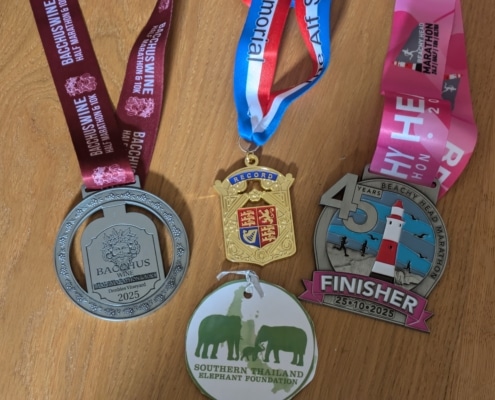
Ros said “I have always jogged for fun and do like to enter events to help me maintain my motivation for training and my fitness. Age is no barrier if you are determined enough. As a STEF Trustee I feel it is important that, as well as assisting in operational and governance aspects of running the charity, I also set an example to others. In this special year though I decided to enter not one but three events – hence the Triple challenge. First the Bacchus Half Marathon in September (in full fancy dress and boiling weather), the second a iconic 10k to celebrate the famous local West Sussex athlete Alfred Shrubb (who was an inspiration to all runners) and then a month later taking part in the gruelling Beachy Head Marathon, just because it was one of the hardest ones I could find in the South East.”
The three combined events involved Ros taking a total of 129,019 steps, burning 7,859 calories and going a combined distance of 173.26 kilometres (45.52 miles) that is only on the event days and doesn’t include all the miles and hours of training in between. Ros added “I am particularly pleased that I went the distance in a respectable time on all occasions, but my proudest achievement is finishing the Beachy Head which is described as one of the toughest in the country with very very steep coastal paths and cliff top ups and downs, muddy tracks, rocky trails and 300 steps and 14 gates on the route – it was very hard but I got my medal!”.
All here at STEF would like to extend congratulations to Ros as well as wishing her a belated happy birthday or dare we say “many happy returns … for your next challenge whatever that may be”. A BIG thank you to all her sponsors too. Ros we look forward to hearing what you are planning next and will behind you all the way…”
Its not too late to sponsor Ros as her Justgiving Page https://www.justgiving.com/page/ros70thtriplechallenge will remain open for a while and you can also see some of her photos and updates on there too.
Photos: Ros at start and Ros at end of Beachy Head marathon and photo of medals of all three events.