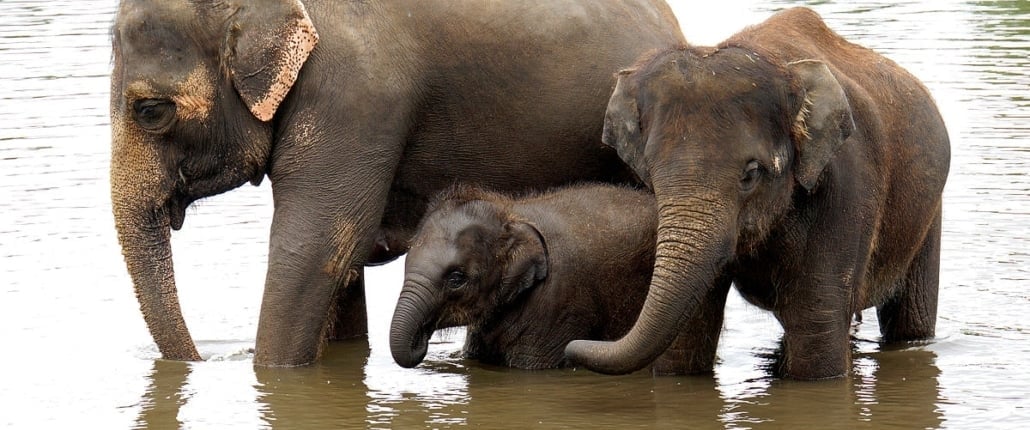
From using solar panels to create clean renewable energy to using recycled rainwater to create our elephant pools, sustainability on the Ban Ton Sae site is one of the ways STEF will become a sustainable environmentally friendly haven for our elephants and guests to enjoy.
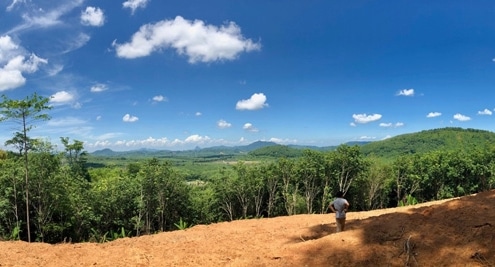
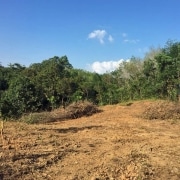
 One of the ways STEF will ensure sustainability is to grow the food for the elephants on site. An area of land has already been sculpted for this purpose and as you can see from the picture (left), levels have been carved into the earth to create giant steps where rows of crops can grow and be rotated.
Deforestation is the biggest threat to the Asian elephant in the wild. Plantations for crops such as rubber and palm oil (products used widely in western countries) are one of the causes for the destruction of elephant habitats. We have cleared all rubber trees from our site and by growing our own food for the elephants we can ensure this land is reused sustainably and no areas of primary forest are cut down to provide the crops.
We plan to grow bamboo and Napier grass (also known as elephant grass) to feed them on site but the elephants will also be taken into the forest to forage for themselves. Elephants need a range of foods to meet their dietary requirements and foraging encourages natural behaviours.
 Why bamboo? Well bamboo (right) is classified as a grass, is extremely strong (big species are often seen being used as scaffolding on construction sites), and it is said to be the fastest growing plant on earth (some species grow up to 0.5m per day). It is sometimes called a ‘pioneer species’, as it creates humus-rich soils and so is of great value in forest habitats. Elephants are very fond of bamboo shoots, seedlings and leaves.
Elephant grass (above left) is a perennial forage crop that also has a fast growth rate, high productivity and has good nutritive value. It is a very good grass for cut and carry systems – and elephants, who do not just eat what is available, but actively choose what to eat, love it as you can see.

If you would like to help us feed our elephants and support sustainable reforestation you can sponsor a tree or area of grazing turf on our website by just clicking here.
 Why raise money for electricity supply lines or diesel-powered generators when we have the sun?
 and clean and produces minimal harm to the environment.
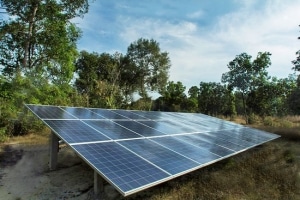 Actually, rain is quite helpful with solar panels as it washes away dirt and debris such as bird droppings, leaves and pollen that otherwise would cover the panels and reduce efficiency.
 on the natural wildlife and their use will help us to minimise our carbon footprint. Producing our own energy in-house will also reduce reliance on third parties, helping us to be sustainably self-sufficient. In any case, the grid can be rather unreliable in the monsoon rain with frequent power cuts!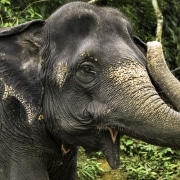
 All of the work on the new site over the past couple of months has somewhat overshadowed the progress of the new trees that we have planted
 . We’ve so far had great support for our Ban Ton Sae Tree Sponsorship scheme, enabling us to plant a further three more kampu trees (known as “Raintrees”), close to the planned area for the elephant hospital. Promisingly, since we’ve had more extensive irrigation installed up the banks, reaching a greater area of the site, each of these trees has leafed really well, even though the monsoon rains are not yet in full swing.
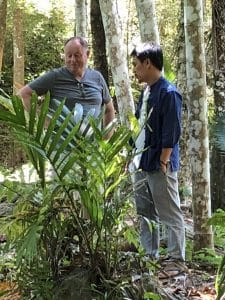
 Jinda’s wise guidance has been influential in helping us choose where to plant the yellow peanut plant (Arachis pintoi), a legume commonly used in pastures for soil improvement and conservation, that will furnish the banks of the entrance to the site with lush, natural greenery, reinforcing our aim of creating an ecologically-sensitive park, both in look and structure. The cuttings were hand-harvested by Jake at a local farm near Phang Nga town (see the photo top left).
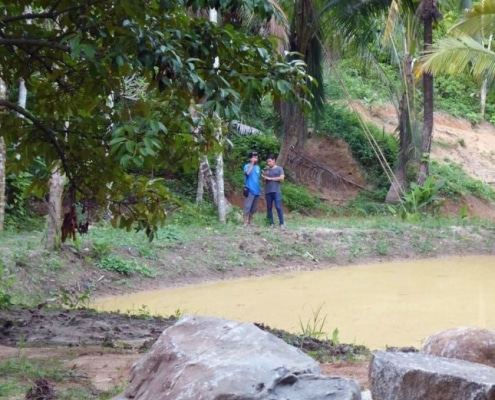 Work on the pools has progressed really well over the last week. The trusty team of five from our chosen contractor, and the fantastic digger driver, speedily completed the planned work on the pools and cascade in just over 2 weeks.
 has been left
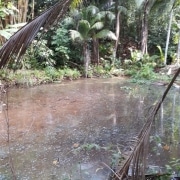 eco-sensitive design of the site to ensure it is in keeping with our ecological ethos.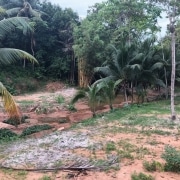
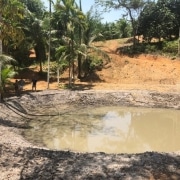 algae. The water supply will extend down to the elephant pool, where an outlet has been installed for a hosepipe so the resident mahouts will be able to shower the elephants before they enter the water to prevent the pool becoming silted up – elephants do love to play with dirt and sand, rolling in the mud in the rain, and throwing it on their backs to protect themselves from the sun. (Dirt sprays also stop those pesky mosquitoes and horseflies landing on the skin!)
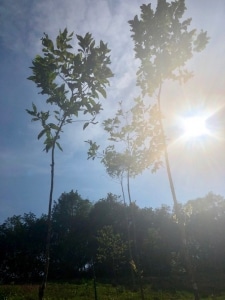
 Over the past few weeks, fourteen new trees have been planted at the STEF site. Each species of tree was carefully chosen to be eco-friendly, to benefit the site for the elephants, and to attract native wildlife.
 the overall beauty of the area while providing vital shade for the elephants.
 Finally, a Banyan tree was planted in the far north east corner of the site, next to the future location of the elephant hospital. The magnificent Banyan tree is not only beautifully alluring for visitors, and impressive in structure, but has cultural and spiritual significance to the area, as legend has it that a spirit is released when a Banyan tree falls and a replacement needs to be planted for the lost spirit to dwell. Workers at the site have claimed to see the mysterious spirit already and hold the newly planted sapling in high regard. Here is a photo of our existing old Banyan tree and you can just make out Jake’s head at the bottom of the picture standing below it’s vast trunk.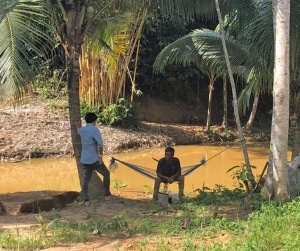
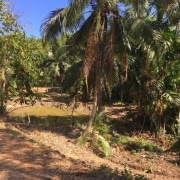 We have been looking at various ideas for the pools with the safety and comfort of the elephants in mind – remembering these are going to be elderly animals needing easy access.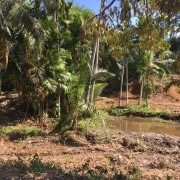
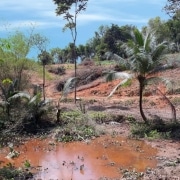
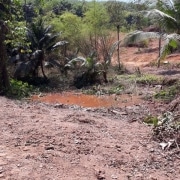
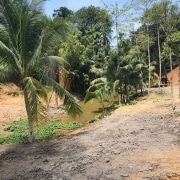 You can help us in our work to make this the most exciting home for retired elephants in Southern Thailand through a donation. As STEF is a UK charity, if you use Gift Aid we can reclaim an extra 25% in tax on every eligible donation made by a UK taxpayer. If you can, please
 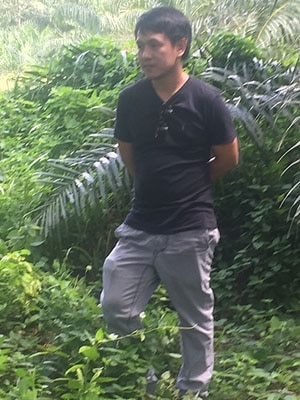 One of STEF’s trustees, Jake Thaotad, is currently based in Thailand and keeps a very close eye on the development work at Ban Ton Sae.
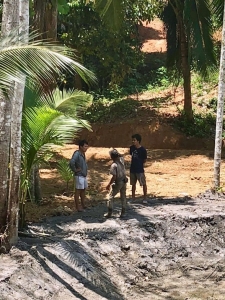 On a recent visit, we asked him for his opinion on how the work is going and what were the future plans.
 build on stilts so elevating the buildings to provide protection against the effects of the heavy rains and to give a more natural look. We need a lot more funding for this next phase, so if you can help us a bit, please do and
 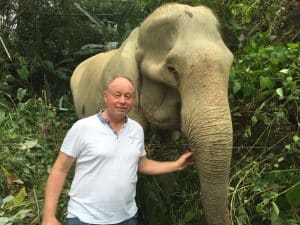 Lee is very well known throughout the elephant world and has a lifetime’s experience working with elephants and other large mammals. He worked in two zoos before joining the Zoological Society of London (ZSL) in the early 1980s. After seven years working with the elephants at London
  Zoo, he moved to Western Australia as Head Elephant Trainer at Perth Zoo, where he spent five years before returning to the UK as Team leader of Elephants at Whipsnade Zoo, where he had 11 Asian elephants under his care. He is particularly proud that ten elephant calves were born during his 21 years at ZSL. He is or has been a consultant for several zoos around the world.
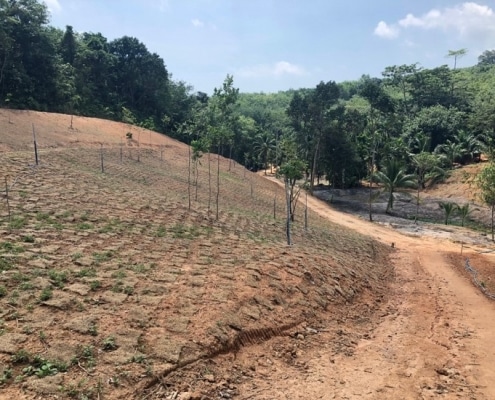 Having structured the land, and then forming the slopes and pathways of STEF, our next step was to lay the turf on the site. It is now late April, and in order to prepare the site for the heavy rain of the monsoon season in the months ahead, and to avoid soil erosion on the slopes and banks from the water runoff, over 9000 square metres of turf needs to be laid to bind the soil together – assisted by the newly planted trees.
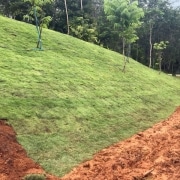 compared to the West. Instead of using grass seed, or long strips of turf, here the turf is cut down small square pieces, and these are then fixed to the soil with a wooden skewer. With grass seed, the heavy rain of the monsoon would saturate the water content of the soil, leading to water runoff and the seeds would simply be washed away and lost altogether. The first batch of turf was planted on the bank east of the first pool, working backwards towards the elephant pool. The work was completed by the wonderful and hardworking couple who have been working on this land for over 40 years, under the supervision of Jake and some of his colleagues.
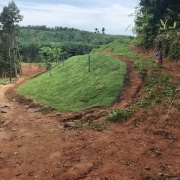 STEF must be the first priority, it is important that we structure the site to have widespread areas where the elephants can naturally graze. Natural grazing is a key factor in maintaining a high level of welfare as it gives the elephant choice and diversity of food, as well as allowing the elephant to use the full range of their trunk’s abilities.