Southern Thailand Elephant Foundation
  • About us
    • Our History
    • Trustees
    • Former Trustees
    • Advisors and Volunteers
    • Our Arts Ambassadors
    • Partnerships
    • Our Donors and Sponsors
    • Contact us
  • How To Help
    • Fundraise for Elephants
    • Challenge Events
    • Donate
    • Sponsor Nam Tarn
    • Adopt
    • Leave a Legacy
    • Vet Volunteers
  • News
  • The Asian Elephant
  • Shop
  • DONATE
  • Click to open the search input field Click to open the search input field Search
  • Menu Menu

Elephants and Religious Teachings

elephants in Buddhism

A temple to Ganesh in Phang Nga Province

Elephants are important to many faiths and cultures, helping to connect people around the world.

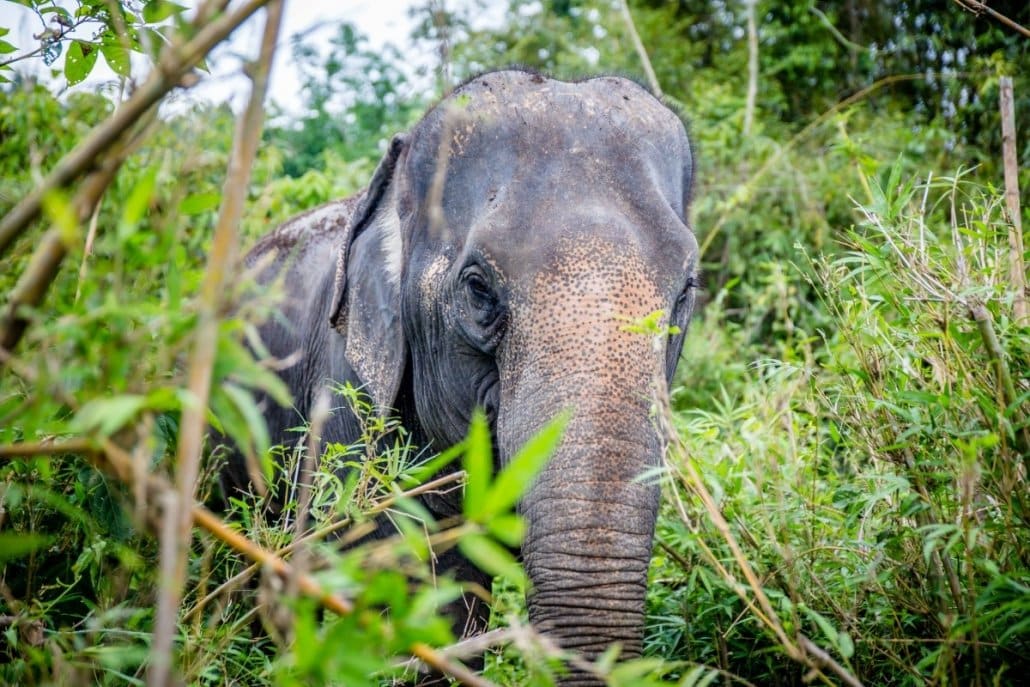
Elephants are known to be determined and very powerful, but can resort to physical aggression when defense is necessary.  Usually, however, they are calm, peaceful and alert. Their unique characteristics are known to influence Thai culture and are closely linked to Buddhism (see part 1, Elephants in Buddhism), but they are also connected to other religions and teachings.

The Buddha

The Buddha often used the example of an elephant in his philosophical teachings. The well-known parable of the Blind Men and the Elephant is usually attributed to The Buddha, whose teachings founded Buddhism. In the story, a group of blind men observe an elephant by touch alone, but begin arguing when they each get different impressions of it. One touches the trunk and says it’s like a snake, one touches the tusk and says it’s like a pole, one touches the leg and says it’s like a pillar and so on. Although focused on the same thing, no one is fully correct. The Buddha used this parable to illustrate the importance of having a complete view[1].  The story can be used to show that although different sects and religions have unique values, they also have shared meanings, and none should be accepted on its own.

The parable also appears in Hindu texts. Elephants are important in Hinduism, from which Buddhism emerged, and the two religions share the same deity, Indra, who rides a flying white elephant called Erawan (or Airavata in Sanskrit – see photo below). Indra and Erawan descend from heaven and battle demons, protecting the earth. In Thailand, Erawan is usually depicted with three heads (although sometimes 33 heads), and is considered to be the king of the elephants and capable of controlling the clouds. This is why the rare white elephants in Thailand are considered to be sacred and are associated with good fortune.

Ganesh

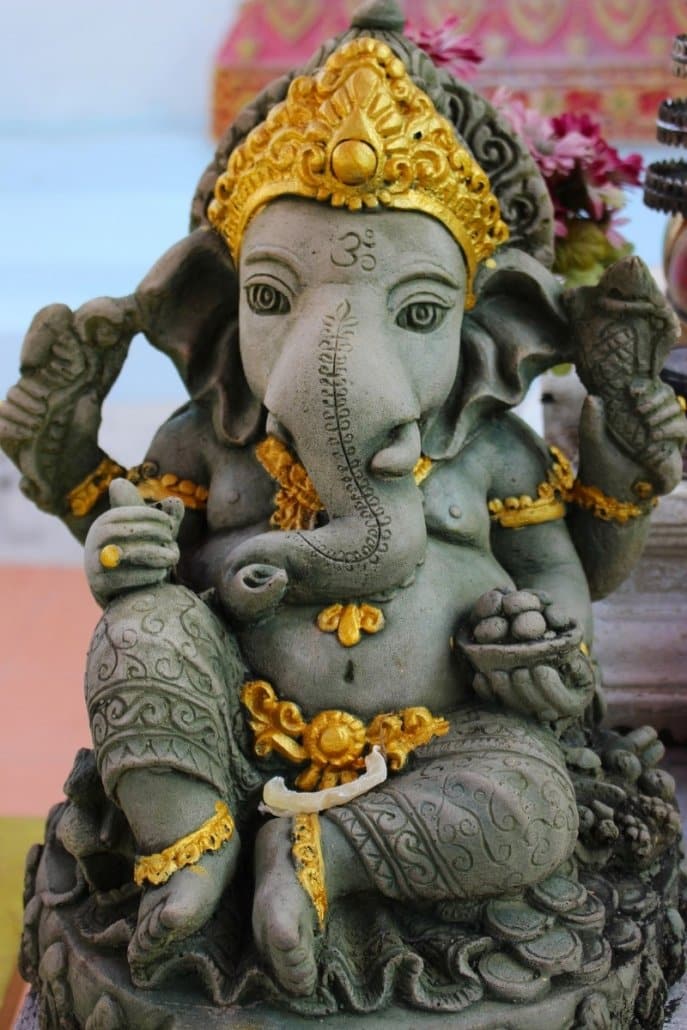
Ganesh (see photo below) is the most universally worshipped Hindu deity. His elephant head, set on a human body, symbolises his wisdom, with his large ears dedicated to listening. Many Buddhists see him as a bodhisattva (someone on the way to enlightenment; see part 1, Elephants in Buddhism) who embodies compassion. His mother, Parvati, made him her guardian, so his image is often depicted around doorways and temples. His trunk is said to sniff out good and evil. Ganesh has a broken tusk; some believe it broke in defending his parents’ home. Other texts describe him deliberately breaking it, dipping it in ink and helping the wise sage, Vyasa, write the Mahabharata  – said to be the world’s longest poem, with over 200,000 lines. This is perhaps why Ganesh is known as the Remover of Obstacles. Many followers see Ganesh as the bringer of fortune and pray to him when facing a challenge. In yoga, the Ganesha Mudra pose can supposedly invoke Ganesh and crush one’s mental barriers.

Elephants have long been a cultural icon in Asia, transcending religions. Nowadays, sadly, conflict often results when elephants are seen as agricultural pests, trampling crops and causing other damage in their search for food. Traditional Thais still worship elephants as sentient beings. They know elephants respond in kind to communication and respect. STEF upholds this philosophy, and we exist to educate communities and protect the Asian Elephant.

[1]”Some monks and priests are attached to their views…like those who see only one side of a thing.”    (Ud.6.4)   https://www.accesstoinsight.org/tipitaka/kn/ud/ud.6.04.than.html

See more here:
https://www.veryshortintroductions.com/view/10.1093/actrade/9780199663835.001.0001/actrade-9780199663835-chapter-1
http://www.swaminarayan.org/festivals/ganeshchaturthi/index.htm
https://www.accesstoinsight.org/tipitaka/kn/ud/ud.6.04.than.html https://www.accesstoinsight.org/tipitaka/kn/ud/ud.6.04.than.html
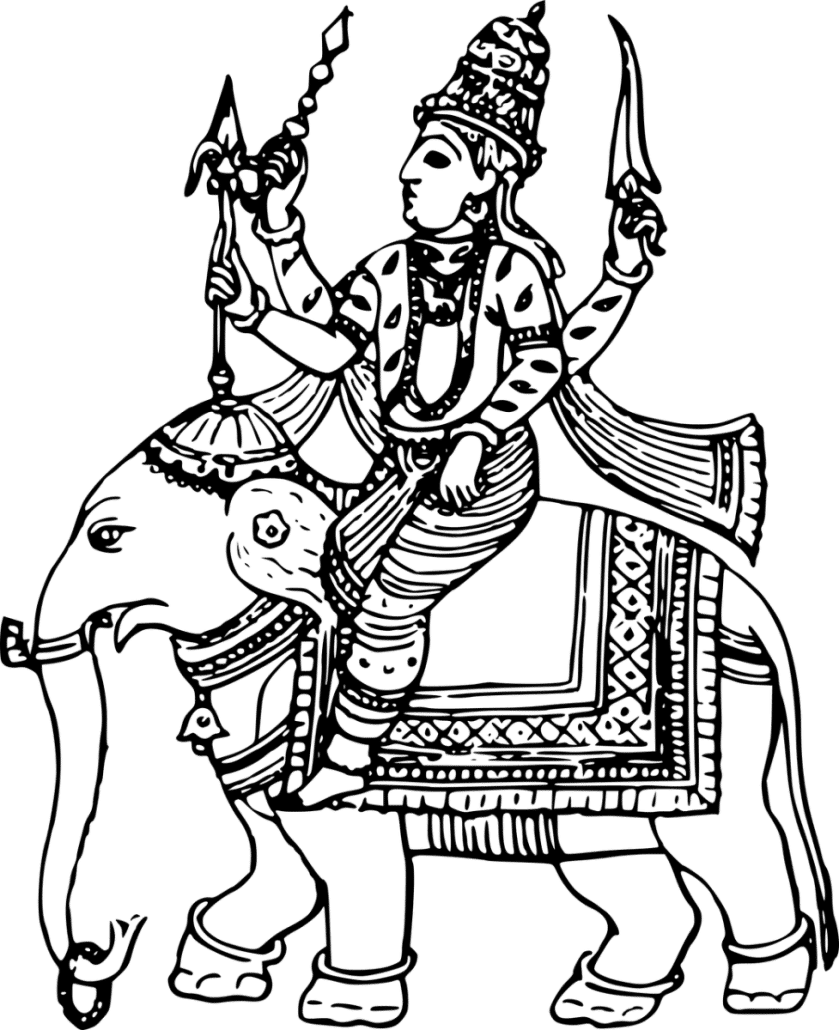
Indra, a deity in both Hinduism and Buddhism

Erawan, sometimes depicted with 33 heads

Ganesh. His elephant head symbolises wisdom

calm and peaceful...

calm and peaceful…

PLEASE DONATE
Share this entry
  • Share on Facebook
  • Share on X
  • Share on WhatsApp
  • Share on Pinterest
  • Share on LinkedIn
  • Share on Tumblr
  • Share on Vk
  • Share on Reddit
  • Share by Mail

Pages

Home
About us
Projects
How you can help
Contact us

Southern Thailand Elephant Foundation

Lakin Rose,
Cambridge House,
Camboro Business Park,
Girton, Cambridge,
CB3 0QH, UK

Email: info@southernthailandelephants.org

Tel: +44 (0) 7440 514362

Registered charity number: 1176322

STEF UK Complaints Policy

Fundraising Regulator
Security Metrics
CAF International
Giving is Great
The Anglo-Thai Society

Follow us on Facebook

Follow us on Social
  • Facebook Facebook Link to Facebook
  • Linkedin Linkedin Link to LinkedIn
  • Instagram-1 Instagram-1 Link to Instagram

© 2026 Southern Thailand Elephant Foundation. All rights reserved.

Scroll to top Scroll to top Scroll to top

This website stores cookies on your computer, which collect information about how you interact with our website. If you would like to find out more about the cookies we use, you can see our Privacy Policy. If you decline, your information will not be tracked; however, a single cookie will be used in your browser to remember your preference not to be tracked.

Accept AllDecline

Cookie and Privacy Settings


How we use cookies

We may request cookies to be set on your device. We use cookies to let us know when you visit our websites, how you interact with us, to enrich your user experience, and to customize your relationship with our website.

Click on the different category headings to find out more. You can also change some of your preferences. Note that blocking some types of cookies may impact your experience on our websites and the services we are able to offer.

Essential Website Cookies

These cookies are strictly necessary to provide you with services available through our website and to use some of its features.

Because these cookies are strictly necessary to deliver the website, refusing them will have impact how our site functions. You always can block or delete cookies by changing your browser settings and force blocking all cookies on this website. But this will always prompt you to accept/refuse cookies when revisiting our site.

We fully respect if you want to refuse cookies but to avoid asking you again and again kindly allow us to store a cookie for that. You are free to opt out any time or opt in for other cookies to get a better experience. If you refuse cookies we will remove all set cookies in our domain.

We provide you with a list of stored cookies on your computer in our domain so you can check what we stored. Due to security reasons we are not able to show or modify cookies from other domains. You can check these in your browser security settings.

Other external services

We also use different external services like Google Webfonts, Google Maps, and external Video providers. Since these providers may collect personal data like your IP address we allow you to block them here. Please be aware that this might heavily reduce the functionality and appearance of our site. Changes will take effect once you reload the page.

Google Webfont Settings:

Google Map Settings:

Google reCaptcha Settings:

Vimeo and Youtube video embeds:

Privacy Policy

You can read about our cookies and privacy settings in detail on our Privacy Policy Page.

Privacy Policy
Accept settingsHide notification only

Help Protect Thailand’s Gentle Giants

    ×